
Achievements
The EDQM’s global outreach and impact
Quality & use of medicines
European Pharmacopoeia
texts published in Pharmeuropa
Ph. Eur. work programme
Biological Standardisation Programme achievements

Total number of projects
25

Concluded projects
3

Projects still running
22

Standard Terms Database key figures

Registered users
47 000

Individual standard terms concepts
1 088

Entries
32 000

Languages
35

European Paediatric Formulary
PaedForm Online Platform
Activities
Five new monographs were officially approved and included in the Paediatric Formulary in 2024.
- Valaciclovir 20 mg/mL oral solution (F0023)
- Amiodarone hydrochloride capsules (5-200 mg) (F0022)
- Flecainide acetate 10 mg/mL oral solution (F0021)
- Clonidine hydrochloride 10 micrograms/mL oral solution (F0018)
- Furosemide 2 mg/mL oral solution (F0003)
Work Programme 2024
- Amiodarone, oral solution (F0024)
- Amlodipine, oral liquid (F0027)
- Azathioprine oral suspension (F0004)
- Chloral hydrate rectal solution (F0016)
- Ethambutol hydrochloride oral suspension (F0012)
- Flecainide acetate, 2mg/mL oral solution (F0017)
- Isoniazid oral solution (F0005)
- Lorazepam oral solution (F0014)
- Midazolam nasal spray (F0019)
- Nifedipine, oral liquid (F0025)
- Omeprazole oral suspension (F0009)
- Prednisolone, oral liquid (F0028)
- Pyrazinamide oral liquid (F0013)
- Pyridoxine, oral liquid (F0030)
- Spironolactone, oral liquid (F0026)
- Vehicle for oral solution or suspension, preserved (F0020)
- Warfarin, oral liquid (F0029)
Reference standards
Certification of suitability to the European Pharmacopoeia monographs (CEP)
Total valid and issued CEPs in 2024

581
new certificates

1 732
revised certificates

+6 800
valid certificates

In 2024 there was a considerable increase in both new certificates issued (up 31%) and revised certificates (up 22%).
The total number of requests for revision of CEPs dropped slightly to 2 360 (down 2%), but new applications increased significantly, to 469 (up 23%).
Finally, the number of inspections conducted in 2024 was comparable to 2023: 30 on-site and 1 RTEMIS. The total of 79 desktop assessments is more than double the number for 2023.
Network of Official Medicines Control Laboratories (OMCLs)
The OMCL Network general activities
EU/EEA specific activities in 2024
OCABR – Surveillance of biologicals for human use
Market surveillance programmes
CAP regular programme
CAP generics programme
MRP/DCP programme
Substances of human origin
Organs, tissues and cells
Blood transfusion
The calculation of the average number of participants does not take into account the study on bacterial testing of platelet components since it was the first full-fledged study of this kind.
Microbiology
- B-PTS074 Bacterial testing of platelet components
Nucleic Amplification Technique (NAT)
- B-PTS075 HBV/HCV/HIV NAT
Serology
- B-PTS076 Anti-HCV
- B-PTS077 HBsAg/Anti-HBc
- B-PTS078 Anti-Treponema
- B-PTS079 Anti-HIV/p24
Immuno-haematology
- B-PTS080 ABO, Rhesus, extended phenotyping and irregular antibodies
Pharmaceuticals and Pharmaceutical Care
recommendations on the classification of medicines and their supply conditions (prescription and non-prescription status) established by the CD-P-PH/PHO and entered into the Melclass database
on reporting of disappearances of medicinal products for human and veterinary use from the legal supply chain, drafted and approved by the CD-P-PH/CMED, adopted by the Council of Europe Committee of Ministers on 10 April 2024
7th CMED workshop for GMP/GDP/Pharmacy inspectors
held in Sofia (Bulgaria) with participants from Bulgaria, Georgia, Republic of Moldova and Romania
EU Heads of Medicines Agencies’ Working Group of Enforcement Officers (HMA-WGEO)
Autumn 2024 meeting co-organised and hosted by the EDQM
Outreach
EDQM events
Webinars
- The new general chapter Comparability of alternative analytical procedures (5.27)
- CEP 2.0: Fresh feedback from stakeholders
- Everything you've always wanted to know about the certification (CEP) procedure
- Joint EDQM–USP Webinar on “Overcoming obstacles in establishing pharmacopoeial reference standards: insights from case studies”
- Introduction to CombiStats web application
- Joint EDQM–USP webinar on “Ethylene glycol and diethylene glycol testing”
EDQM conferences, symposiums, meetings, workshops, etc.
Full information on EDQM events is available on our “Events & training” page.
Participation
The EDQM also participates in external events, including the following.
- Job forum of the Comité des Etudiants en Pharmacie Industrielle (CEPhI), Strasbourg
- ISBT Exhibition
- CPhI Worldwide – Milan
Training sessions
2024 EDQM Virtual Training Programme: European Pharmacopoeia texts related to Biologicals and on Microbiology chapters
CombiStats training
Other training sessions and events
- Pharmacopoeial Discussion Group (PDG) stakeholder event - The PDG is going global
- BINACLE Assay for Tetanus Neurotoxin: Outcomes of Project BSP136
- 2024 EDQM training – Module 1: General methods, general chapters and general monographs
- 2024 EDQM training – Module 2: Individual monographs – Focus on chemically defined active substances and medicinal products
- 2024 EDQM training – Module 3: Impurity control in the Ph. Eur.
- 2024 EDQM training – Module 4: Ph. Eur. reference standards
- 2024 EDQM training – Module 5: Fundamentals of the CEP Procedure
- 2024 EDQM training – Module 6: Building successful CEP dossiers: new applications
- 2024 EDQM training - Module 7: Building successful CEP revision applications
- 2024 EDQM training – Module 8: Control of impurities: CEP approach
- 2024 EDQM training – Module 9: The EDQM inspection programme
- Advancements in gene therapy: the European Pharmacopoeia’s new approach
Articles published in scientific journals
New EDQM publications
- Guidance on essential oils in cosmetic products (2nd edition)
- Guidelines on medication review
- Guidance to disseminate the deliverables related to pharmaceuticals and pharmaceutical care
- Metals and alloys used in food contact materials and articles (2nd edition)
- Documentation supporting compliance and safety of food contact materials and articles
Quality management system
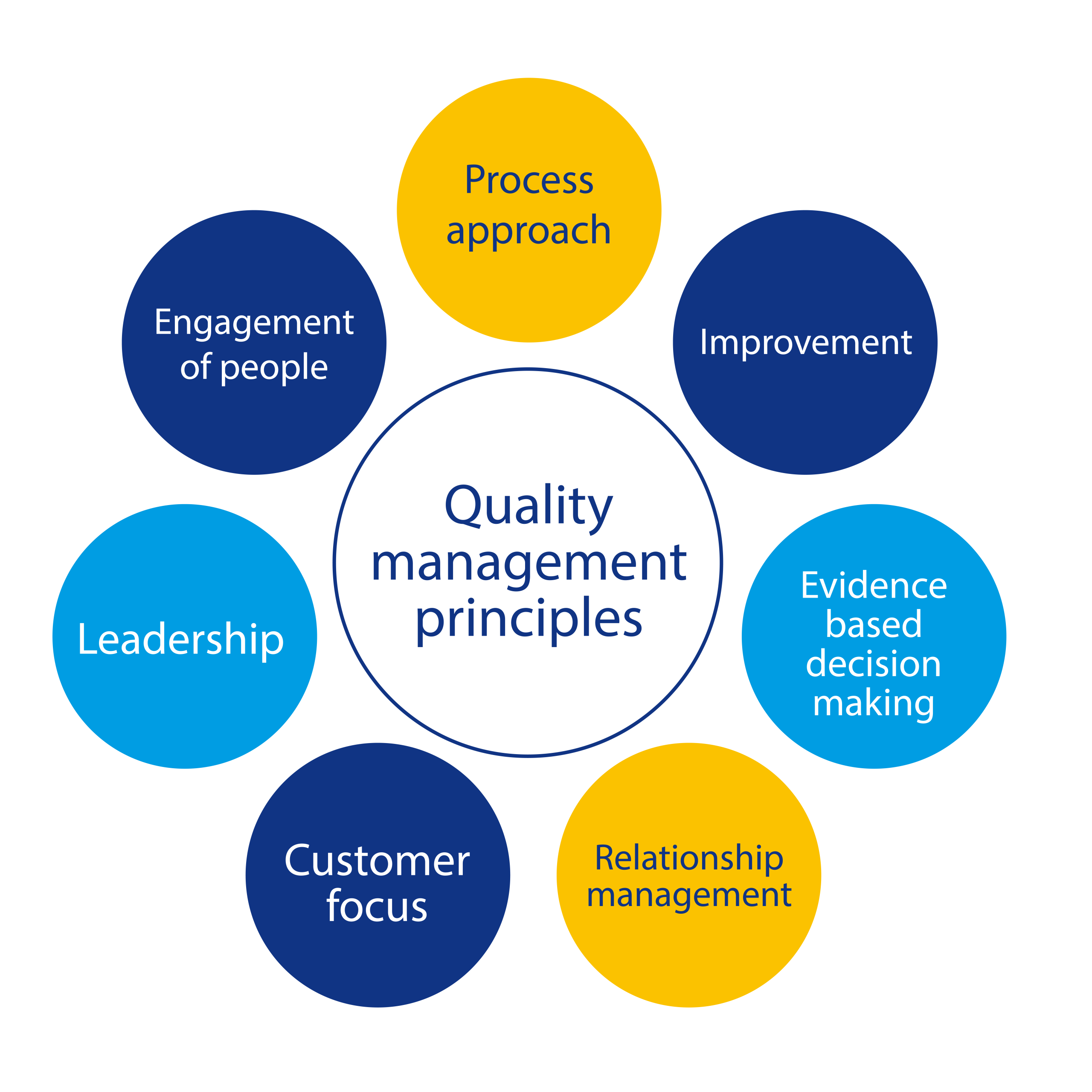
One of our strategic objectives is to modernise our working methods to increase the quality and efficiency of our contribution to public health. Quality management therefore remains a high priority. The EDQM deploys risk-based thinking to the planning and implementation of its quality management system processes, in line with the requirements of ISO 9001:2015, applying the seven related quality management principles:
Addressing risks and opportunities enhances our effectiveness, improves results and prevents negative effects. It also enables us to sustain our vision and mission and guarantee the best products and services.
The EDQM Laboratory is accredited for ISO/IEC 17025:2017 – “General requirements for the competence of testing and calibration laboratories”, demonstrating that the laboratory operates a quality system, is technically competent and is able to generate technically valid results. Sixteen EDQM Laboratory’s techniques are covered by this certificate.
The EDQM makes all necessary efforts to continually develop and improve its quality management system. Its customers and interested parties can therefore have faith in the consistent quality of the goods and services provided by the EDQM.